Tree Diversity, Biomass and Carbon Storage in Sacred Groves of the Shivalik Foothills, Garhwal Himalaya, India
Amit Chettri
Department of Forestry, Dolphin (PG) Institute of Biomedical and Natural Sciences, Manduwala, Dehradun, 248007, Uttrakhand, India.
A.K. Uniyal
*

Department of Forestry, Dolphin (PG) Institute of Biomedical and Natural Sciences, Manduwala, Dehradun, 248007, Uttrakhand, India.
Vikaspal Singh
Department of Forestry, Dolphin (PG) Institute of Biomedical and Natural Sciences, Manduwala, Dehradun, 248007, Uttrakhand, India.
Sandhya Goswami
Department of Forestry, Dolphin (PG) Institute of Biomedical and Natural Sciences, Manduwala, Dehradun, 248007, Uttrakhand, India.
Manish Kumar
Department of Forestry, Dolphin (PG) Institute of Biomedical and Natural Sciences, Manduwala, Dehradun, 248007, Uttrakhand, India.
Prabhakar Manori
Department of Forestry, Dolphin (PG) Institute of Biomedical and Natural Sciences, Manduwala, Dehradun, 248007, Uttrakhand, India.
Bhagyashree Debbarma
Department of Forestry, School of Natural Sciences, H.N.B. Garhwal University, Srinagar Garhwal, India.
*Author to whom correspondence should be addressed.
Abstract
Background: Vegetation especially trees play an important role in mitigating climate change by absorbing atmospheric Carbon dioxide (CO₂) through photosynthesis and storing it in biomass acting as a natural carbon sink.
Aim: This study aimed to assess tree diversity and estimate the above-ground biomass (AGB) and carbon storage status of four sacred groves (Sidh Peeths).
Place and Duration: Sacred groves were located in the Dehradun Valley, within the Shivalik foothills. Field investigations were carried during October 2024 to April 2025.
Study Design and Methodology: Analysis of tree vegetation was done to assess the species diversity and distribution across four selected sacred groves. In each of these grove, ten quadrats of 10m×10m (100m²) were randomly laid. Tree species were identified and parameters such as density, frequency, abundance was calculated using standard methods. Biomass and Carbon storage were estimated using species specific volume equations.
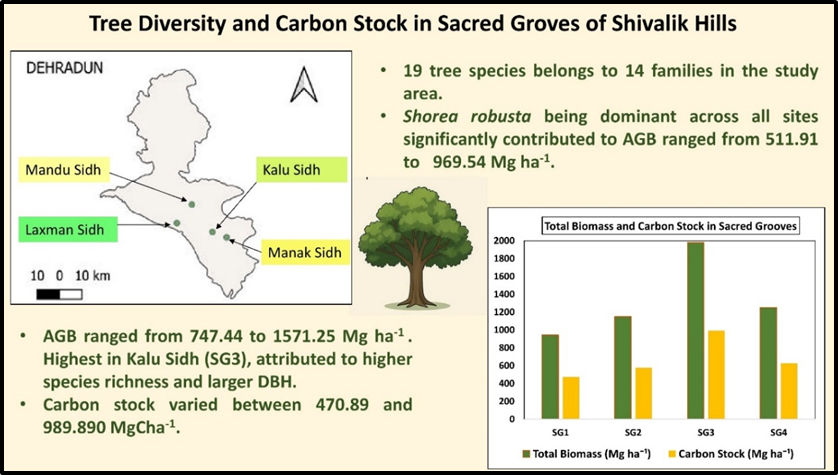
Results: Tree species richness varied across the groves, ranging from 3 to 12 species, with Shorea robusta emerging as the dominant species in all sites. Tree density ranged between 650 and 860 trees per hectare. AGB was calculated by multiplying tree volume with wood density, followed by application of a biomass expansion factor. The estimated AGB ranged from 747.44 to 1571.25 Mg ha⁻¹, while carbon stock ranged from 470.89 to 989.89 Mg C ha⁻¹.
Conclusions: Kalu Sidh (SG3) recorded the highest values for both AGB and carbon storage likely due to its greater species richness and higher mean DBH. Shorea robusta contributed the largest share of AGB across all groves.
GRAPHICAL ABSTRACT
Keywords: Biodiversity, biomass, sacred grove, carbon storage, Shivalik foothills