Assessment of Microplastic Contamination and Ecological Risk in the Middle Stretch of the Sutlej River, Punjab, India
Pullagura Siva Nagendra

Department of Fisheries Resource Management, College of Fisheries, Guru Angad Dev Veterinary and Animal Sciences University, Ludhiana - 141004, Punjab, India.
Surjya Narayan Datta
*
Department of Fisheries Resource Management, College of Fisheries, Guru Angad Dev Veterinary and Animal Sciences University, Ludhiana - 141004, Punjab, India.
Devendra Pathak
Department of Veterinary Anatomy, College of Veterinary Science, Guru Angad Dev Veterinary and Animal Sciences University, Ludhiana - 141004, Punjab, India.
Grishma Tewari
Department of Fisheries Resource Management, College of Fisheries, Guru Angad Dev Veterinary and Animal Sciences University, Ludhiana - 141004, Punjab, India.
Kuldip Gupta
Department of Veterinary Pathology, College of Veterinary Science, Guru Angad Dev Veterinary and Animal Sciences University, Ludhiana - 141004, Punjab, India.
Geeta Devi Leishangthem
Department of Veterinary Pathology, College of Veterinary Science, Guru Angad Dev Veterinary and Animal Sciences University, Ludhiana - 141004, Punjab, India.
*Author to whom correspondence should be addressed.
Abstract
Aims: The study was conducted to evaluate microplastic (MP) concentrations in water samples.
Place and Duration of Study: For the comparative assessment of the MP pollution 54 water samples have been collected on a bimonthly basis from September 2024 to February 2025 from selected sampling station of Sutlej River in Punjab, India.
Study Design and methodology: The Microplastic was screened by following National Oceanic and Atmospheric Administration (NOAA) protocol on a hot plate for 30 to 40 minutes at 50°C. Immediately wet peroxidation process was utilized. Following density separation was carried out with NaCl and ZnCl₂ solution.
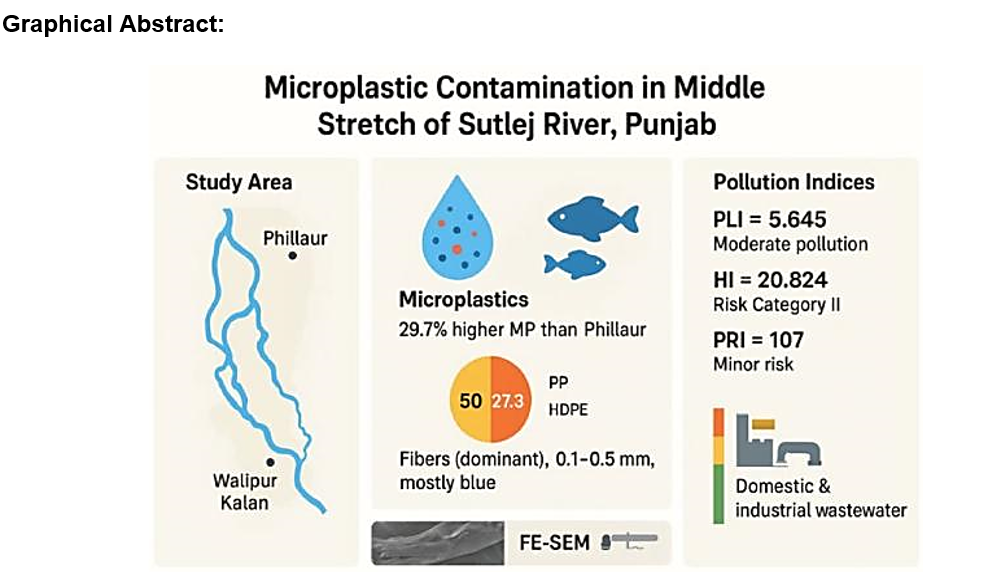
Results: Fibers, 0.1 to 0.5 mm size range and blue colored particles were the most dominant. p-values were < 0.05, which were considered as statistically significant difference. Through surface morphological analysis using FE-SEM, degradation features such as pits, grooves, cracks, sharp edges and fractured surfaces were observed. Among identified MP-polymers polypropylene (PP) was the most abundant type observed. Water from Walipur Kalan contained 29.7% more MPs than Phillaur because of continuous influx of polluted water influx from Buddha Nullah. Based on the risk index, the Sutlej River was classified as moderately polluted which indicates significant contamination.
Conclusion: The need for focused management strategies was highlighted by identifying untreated wastewater releases from domestic and industrial sources as likely sources of contamination.
Keywords: Microplastics, pollution, polymer, Sutlej Rivers, bio magnification