Trend Analysis of Global Energy Demand, Renewable Energy Production and Potential in India
R. Krishna
Aryabhatta College, University of Delhi, Benito Juarez Road, New Delhi-110021, India.
Mansi Vaid
Aryabhatta College, University of Delhi, Benito Juarez Road, New Delhi-110021, India.
Manoj Sinha *
Aryabhatta College, University of Delhi, Benito Juarez Road, New Delhi-110021, India.
*Author to whom correspondence should be addressed.
Abstract
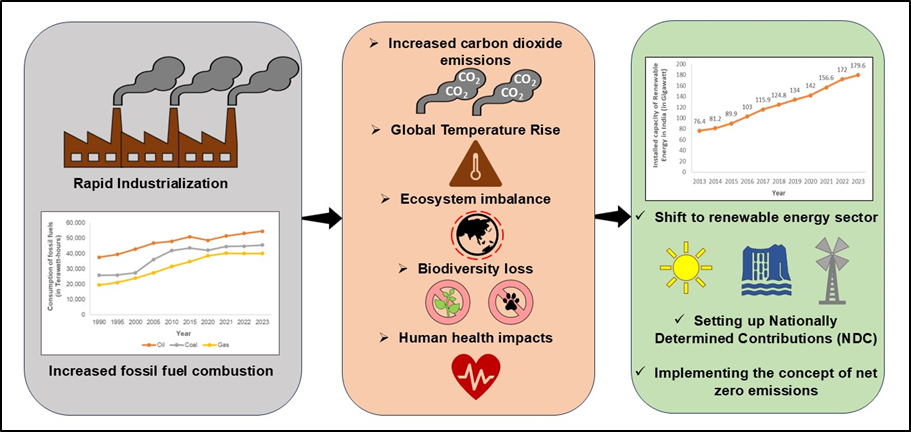
The continuously degrading state of the environment due to increasing fossil fuel consumption demands a quick overturn in the resource consumption patterns i.e., shift from non-renewable assets like fossil fuels to renewable assets. The present review focuses on this theme and evaluates the trends of fossil fuel consumption, carbon dioxide emission, temperature fluctuations, renewable energy transitions, and efforts to reduce climate change with a special emphasis on India. Data-driven trend analysis provides useful insights into the consumption patterns, environmental trends, and energy transition analysis, which can help in strategic planning and development of policies for sustainable growth. The Industrial Revolution has significantly contributed to climate change, primarily through the combustion of fossil fuels such as coal, oil, and natural gas for energy production. As a result, global temperatures have risen. If the current trajectory continues, average global temperatures may exceed pre-industrial levels by more than 1.5°C within the next two decades according to IPCC. To counter this, transitioning from fossil fuels to renewable energy is critical, particularly in the power sector, which is among the largest contributors to CO₂ emissions worldwide. India is one of the leading emitters of CO2 worldwide contributing 8.2% of the global emissions. To reduce its carbon footprint, India has developed around 179.6 GW of capacity from renewable energy sector. As per 2021 Nationally Determined Contributions (NDC), India has committed to fulfill nearly 50% of its electrical needs from non-fossil fuel-based energy resources by 2030. The Indian government is actively promoting renewable energy through various policies, incentives, and subsidies aimed at scaling up clean energy technologies. This review highlights these pressing concerns and emphasizes the importance of coordinated action by policymakers, industries, and civil society to mitigate climate change and secure a healthier environment for future generations.
GRAPHICAL ABSTRACT
Keywords: Global warming, climate change, fossil fuel, renewable energy resources, sustainability