Enhancing Conservation Strategies for Wild and Migratory Bird Habitats in South Asia: A Comprehensive Review
Md. Humayon Kabir
Upazila Livestock Office and Veterinary Hospital, Mohonpur, Rajshahi, Bangladesh.
Raf Ana Rabbi Shawon
Laboratory of Wildlife Resources, Gifu University, Gifu 501-1193, Japan.
Md. Kamrul Haque
Institute of Bangabandhu War of Liberation Bangladesh Studies (IBLBS), Dhaka-1209, Bangladesh.
Israt Jahan Shyama
Department of Accounting, University of Dhaka, Dhaka-1000, Bangladesh.
Md Amirul Islam
Department of Sanskrit, University of Rajshahi, Rajshahi-6205, Bangladesh.
Most. Sumsun Nahar Saila
Computer Science and Engineering, Varendra University, Rajshahi-6204, Bangladesh.
Md. Jannat Hossain
Department of Microbiology and Public Health, Khulna Agricultural University, Khulna-9100, Bangladesh.
Md. Matiur Rahman *
Department of Medicine, Sylhet Agricultural University, Sylhet-3100, Bangladesh.
*Author to whom correspondence should be addressed.
Abstract
Birds are important elements of an environment. The review articles show the significance, challenges, and conservation strategies for wild and migratory bird habitats in South Asia which have diverse landscapes host crucial ecosystems, providing breeding grounds, stopovers, and wintering areas for countless bird species. Anthropogenic activities, climate change, pollution, and invasive species threaten these habitats, necessitating effective conservation measures. Habitat assessment, monitoring, restoration techniques, and adaptation strategies are explored. The impact of climate change on bird habitats is discussed, emphasizing the importance of habitat resilience and adaptive management. Community engagement and education are pivotal in conservation, with successful models involving local communities in decision-making processes. The article also addresses the status of illegal bird hunting in the Indian subcontinent, emphasizing the need for strengthened law enforcement and community involvement. Though birds are important element of the environment, however, they are cause to spread some disease in especially migratory birds. It’s have contribution to biodiversity, pest control, and pollination but can also cause economic losses in agriculture and pose risks to aviation. Managing coexistence between birds and human activities is required for successful conservation program. Interdisciplinary research, long-term monitoring, and quantitative assessments of habitat resilience is underscored. The article concludes with a future plan for wild and migratory bird management in Bangladesh, outlining measures such as habitat protection, community involvement, and international collaboration.
Graphical Abstract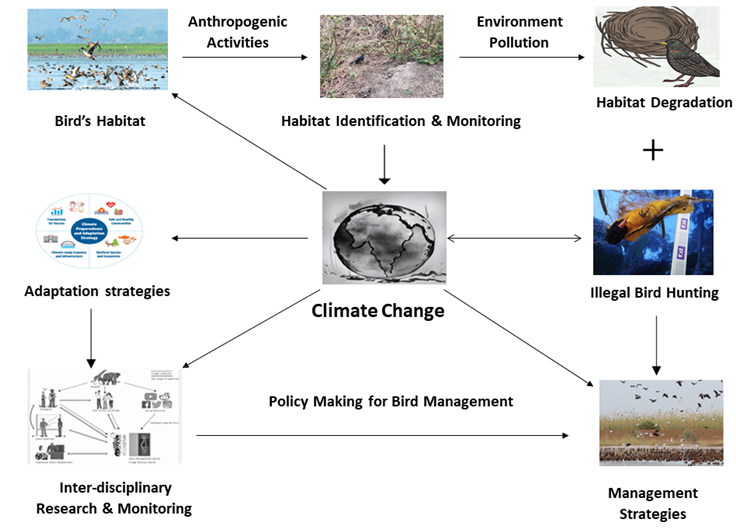
Keywords: Wild and migratory birds, climate change, adaptation, habitat management